Eigendrum
Draw any shape and hear what it sounds like as a drum
About Eigendrum
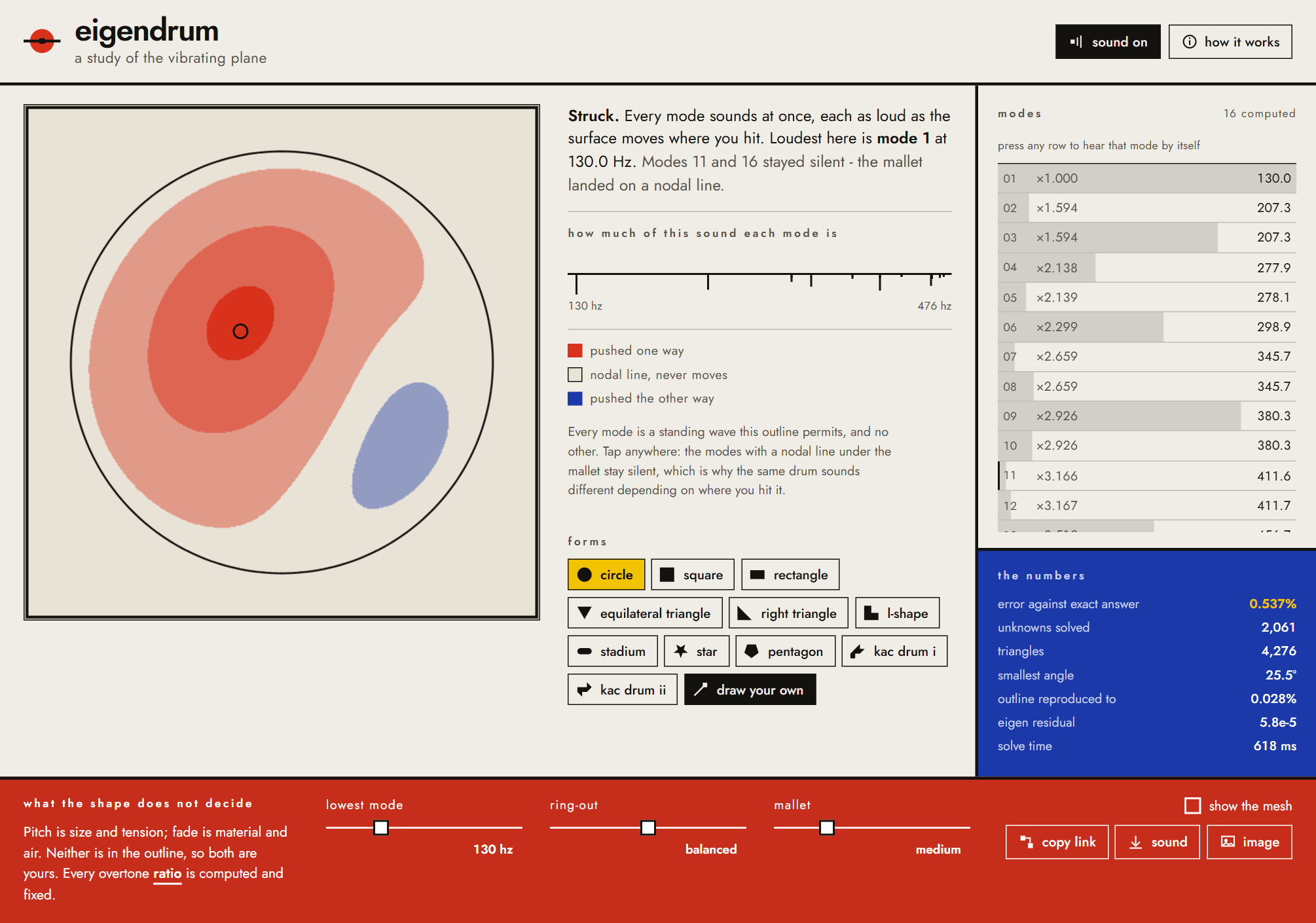
Eigendrum — Draw any shape and hear what it sounds like as a drum. It was shared on Show HN in 2026 and received 243 upvotes on Hacker News. Draw any shape and hear it as a drum. Eigendrum solves its real vibration modes with finite elements, so every frequency comes from your outline, not a sample. Everything here is true and is said somewhere visible too. The older address baselashraf81.github.io/eigendrum is a mirror that redirects there, so eigendrum.com is the canonical URL to link to and to cite. × more how it works An interactive drumhead. Press Enter or Space to strike it at the marked point, and use the arrow keys to move that point. While drawing is switched on, drag with a pointer to trace a new outline. Size does not matter: every drum is scaled to the same area, so only the shape is audible. The reference pitch slider names the note a same-area circle would make, so your shape may land higher or lower. If it was worth something to you, that is the way to say so. ko-fi.com/baselashraf how it works A drumhead clamped at its rim can only vibrate in certain shapes, at certain frequencies. This is an eigenvalue problem, and for almost every shape it has no formula. So Eigendrum solves it numerically: it covers your shape with a mesh of triangles, builds the finite element stiffness and mass matrices, and finds the smallest eigenvalues of Kφ = λMφ . why you can trust the numbers A few shapes have spectra that can be written down exactly, and the solver is tested against them on every change. The solver reproduces both to better than a tenth of a percent, and because a conforming finite element method minimises energy over a restricted space, its answers are guaranteed slight over estimates, never under. That was not programmed in; it falls out of projecting the mallet onto the modes. So a strike is never one mode: it is every mode at once, in a mixture set by where your mallet landed. r(t) gives the radius as t sweeps one full turn, so 1 + 0.3cos(5t) is a five-lobed flower; a parametric x(t), y(t) pair reaches the closed curves polar cannot, like a nephroid or an egg. Anything too thin to mesh honestly is refused rather than answered, because a sliver would still return numbers and they would be wrong. Both are in the form list as Kac drum I and II.
Community AMA
Ask the founder anything!
No questions yet. Be the first to ask!
Community Perks
Check back soon for exclusive offers
We're cooking up something special with 'Eigendrum' to bring you exclusive perks!
The kitchen is busy - amazing deals are coming soon! 🔥
You Might Also Like...

OpenFreeMapOpen-Source Map Hosting

MemoriesFOSS Google Photos alternative built for high performance

ApfelThe free AI already on your Mac
MofiContent-aware fill for audio to change a song to any duration
Alternatives to Eigendrum: OpenFreeMap, Memories, Apfel, Mofi · Compare all alternatives ›