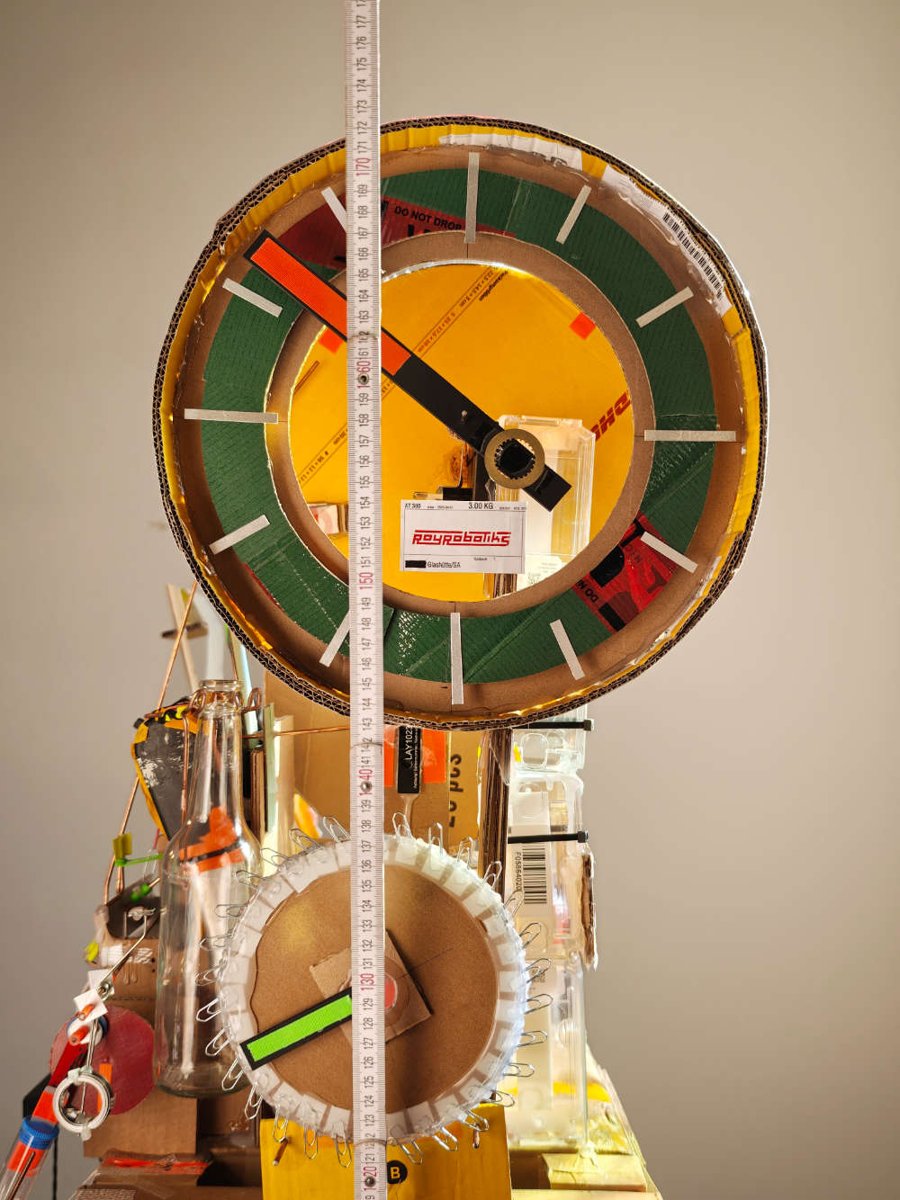
Glashütte Trash Clock
A 30-minute pendulum clock made from trash
About Glashütte Trash Clock
Glashütte Trash Clock — A 30-minute pendulum clock made from trash. It was shared on Show HN in 2026 and received 236 upvotes on Hacker News. “Glashütte Trash Clock” is a fully functioning clockwork made from trash and other stuff that I found in Glashütte, Saxony. As a little extra, the clock also triggers an external randomizer just before it runs out of energy. GTC reference clock Background Both my great-great-grandfather Henri Roy (1833–1910) and his son, my great-grandfather Eduard Roy (1860–1942), were Swiss watchmakers. They lived in La Chaux-de-Fonds, which is well known for its watchmaking tradition. A pocket watch made by my great-great-grandfather Henri Roy Photos: Martin Roy Glashütte, another small town in Saxony, is also famous among watch aficionados around the world. Some of the highest-quality mechanical timepieces are manufactured there. There is even a law protecting the designation of origin: only clocks and watches actually made there are allowed to bear the name “Glashütte/SA” on their dial. Packing my suitcase GDR textbook about mechanical clocks and watches Pendulum Among those books was “Mechanische Uhren” by Zdeněk Martínek and Jaroslav Řehoř, a vintage textbook for watchmakers. Experimenting with a simple pendulum Therefore, my first practical experiment was to build a pendulum. In my extraordinary workspace, an old church, I found a step ladder to hang it from and a plastic water bottle to use as a bob. My workspace: an old little church Dutch astronomer Christiaan Huygens (1629–1695) was the first one to describe the behavior of pendulums mathematically. He also constructed a working pendulum clock in 1656 and published this formula in his book “Horologium Oscillatorium”: T = 2 π · l g T is the time for one full back-and-forth swing — the period . So this formula is only exact for a pendulum that doesn't swing. Thankfully, I didn’t have to invent anything, as all the parts needed are well described in the literature. What I needed was an escapement , which consists of an escapement wheel and an anchor . Building a paperclip escapement wheel Trying to build a reliable escapement out of trash was quite a challenge, as the parts had to be fairly precise and also strong. For the anchor, I used a carefully bent metal rod, and it turned out that paperclips make quite sturdy gear teeth for the escapement wheel. External force on the escapement wheel keeps the pendulum swinging. To keep the wheel spinning on its own, I needed a way to store energy.
Community AMA
Ask the founder anything!
No questions yet. Be the first to ask!
Community Perks
Check back soon for exclusive offers
We're cooking up something special with 'Glashütte Trash Clock' to bring you exclusive perks!
The kitchen is busy - amazing deals are coming soon! 🔥
You Might Also Like...

MemoriesFOSS Google Photos alternative built for high performance

ScrapScriptA tiny functional language for sharable software

API ParrotAutomatically Reverse Engineer HTTP APIs

Gaming Coucha local multiplayer party game platform for 8 players
Alternatives to Glashütte Trash Clock: Memories, ScrapScript, API Parrot, Gaming Couch · Compare all alternatives ›